 |
 |
 |
Gelidium purpurascens
Gel Weed
27 October 2025
Terrace Beach, Ucluelet, B.C., Canada.
Tide: 6.6 feet (measured at Ucluelet Tidal Station) at 10:30am PDT (time of interaction in-situ)
Weather: Overcast, occasional rain showers; wind variable 5 – 15 km/hour, sea rippled, low westerly swell, humidity 97%, 8 ˚C.
Moon: Waxing Crescent (31.8%, 6 days); Next Phase, First Quarter, 29 Oct 2025 at 9:20am PDT: Previous Phase, New Moon, 21 Oct 2025 at 5:25am PDT.
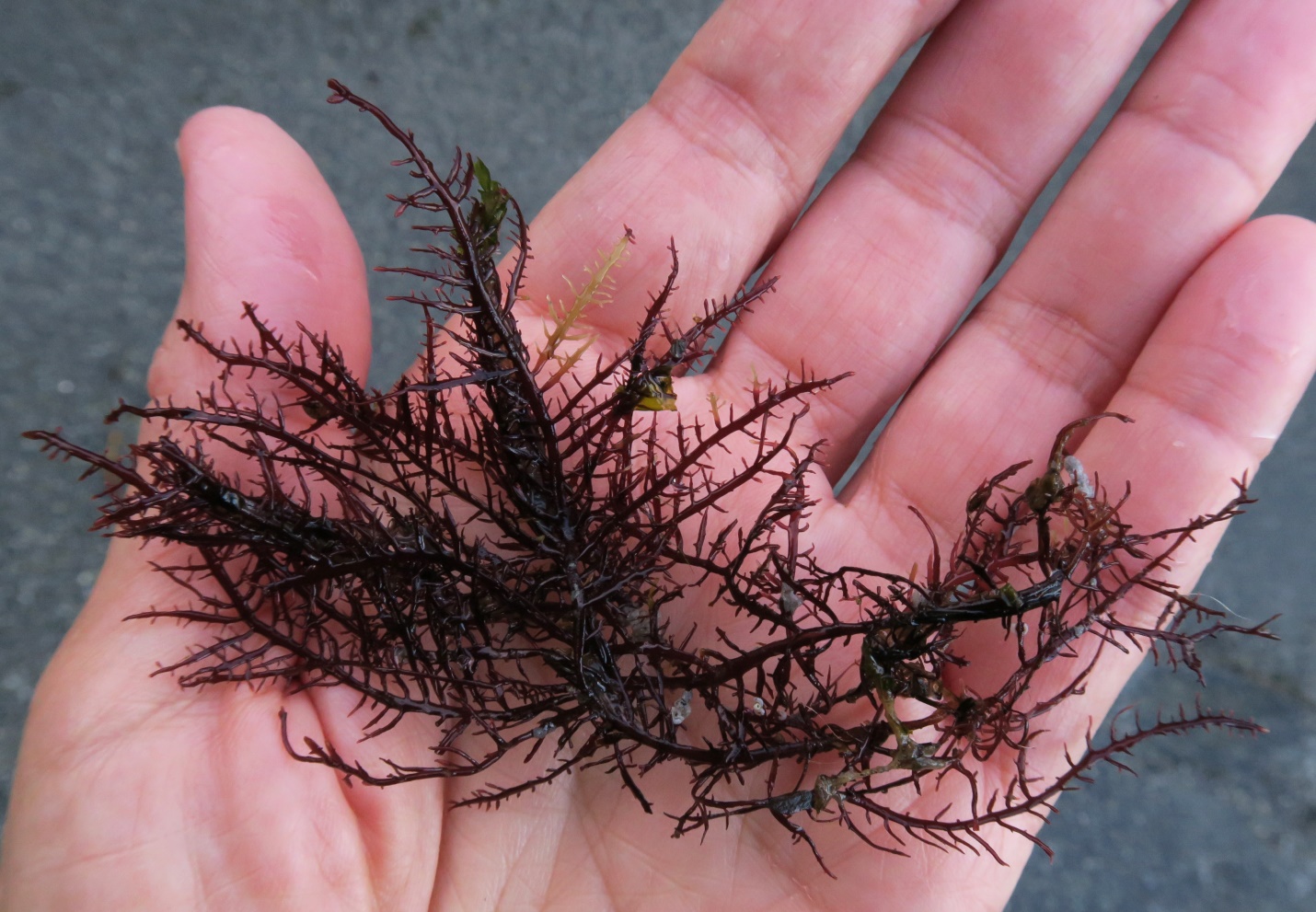
Figure 1: A cast ashore individual, this was one of several Gelidium purpurascens individuals found this day. It had been buried under other larger marine algae but still was stiff and spunky! Terrace Beach, Ucluelet, B.C., Canada. October 27, 2025. Photo ID 27881 ©Seaweedwhisperings.com
Person 1:
Erect.
Perky.
Strong.
Thallus is shiny; knight in “shining” armor.
Ready to take on the world.
Ready to lash out with its multi-branched swords.
Not angry, but ready to fight, perhaps mainly to defend.
Can be short-sighted in its goals and actions. Reactionary rather than proactive.
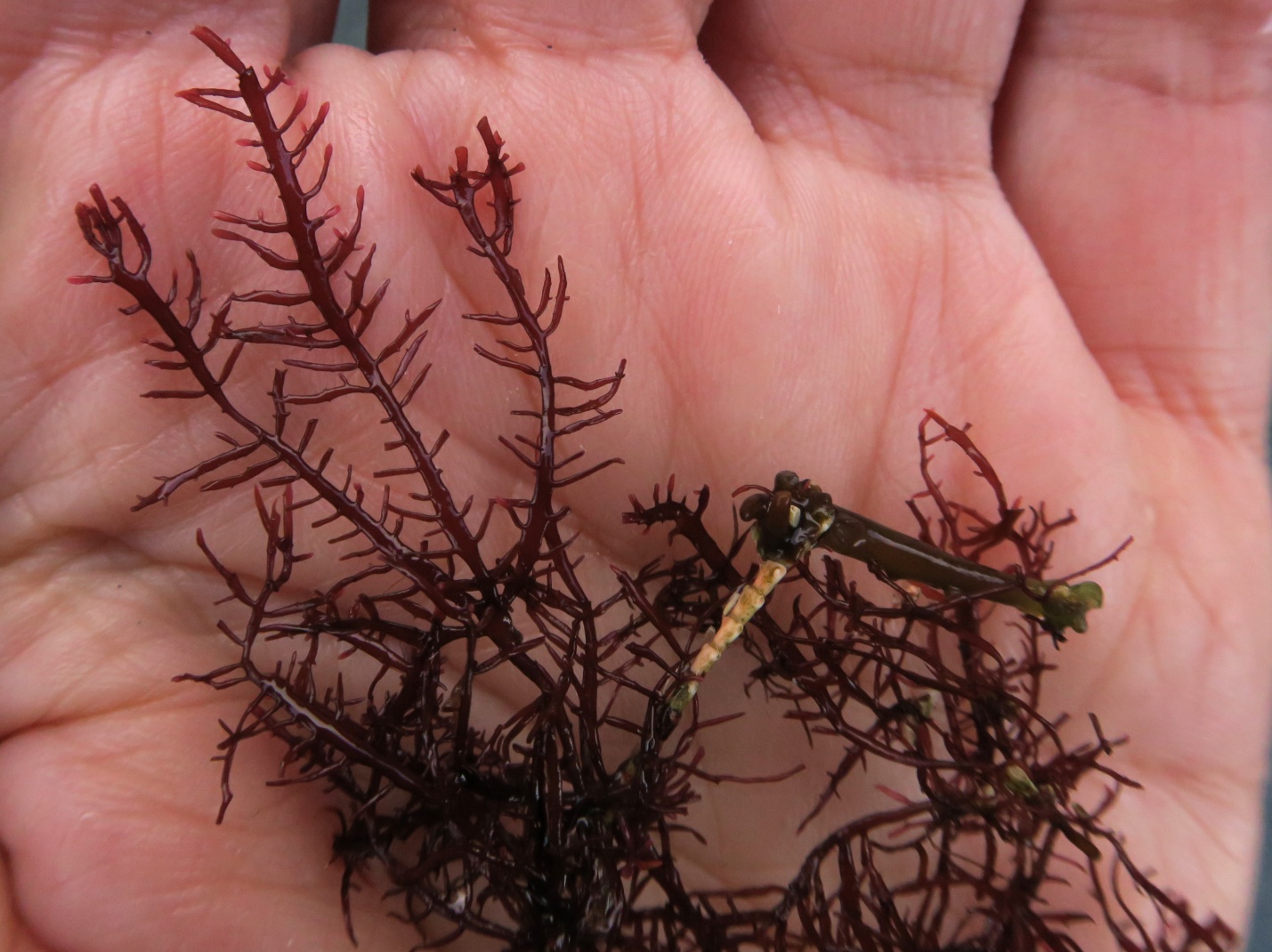
Figure 2: This Gelidium purpurascens looks as if it was growing epiphytically from a segment of an articulated coralline alga (the four linked pinkish sections that are in the center of the photo). There are some other pieces of algae involved in this mix, so the actual host seaweed may differ. Terrace Beach, Ucluelet, B.C., Canada. October 27, 2025. Photo ID 27882 ©Seaweedwhisperings.com
Person 2:
Lying beneath other cast ashore marine algae on the beach today – most of which is MUCH larger in size, we found several Gelidium individuals. This red alga is stiff and spunky – it didn’t get flattened or crushed by the weight of other cast ashore species.
moprhologyMain axes are small, but prominent for the overall size – they’re also somewhat flattened especially towards the the tips.
Branches come off the axes in opposite pairs and teeny tertiary level branches are also oppositely positioned. Wait a moment…, the branching is not always opposite, and not quite alternate… it’s not following a strict pattern yet the arrangement of branches is somehow distinctive. This lack of consistent branching pattern fits in with your overall look which I can only call a bit ‘disorderly’.
Your red coloration is truly lovely, though, and it does have some purplish tones to it just as your scientific name suggests.
Also the “gel” look comes through when magnified – but it is only a gelationous “look” – your texture is much more stiff and cartilaginous.
We found some of you growing from a Neogastroclonium subarticulatum seaweed, and another from a segment of a calcified coralline algae. For comparison purposes we even found one example of Gelidium coulteri – a relative from the same genus of red algae, this is another stiff little seaweed but “wiry” may be the best word for it and it is much smaller than you, G. purpurascens, and unlike you, it is is a turf-forming species.
Gel Weed has a strong will, and it builds on that as it grows. Ideas are “fed”/nourished by fairly regular, short, side explorations. And these side explorations are roughly balanced, they go both right and left, east and west. They don’t get too carried away in one direction before feeling an interest in checking out other ones. Side explorations don’t ever become the “main” thrust for them, but they supplement and contribute to the “main thrust”.
Stiff – they will stand their ground.
And FLEXIBLE; I can bend the thallus tightly back upon itself and it doesn’t break. Relating this back to their strong will, it seems that this will be tested in their life. Even the bending forces that occasionally happen don’t really change your direction, Gelidium purpurascens. You bear the weight, the stress, whatever is stronger and heavier that bends you over, and then, as soon as that has let up, you bounce back to where you were.
From a distance as I glance at this seaweed it looks like a “messy collection” of fairly intricately formed branches. It doesn’t really say “look at me”, not at all. Instead I think that Gelidium is the one doing the looking, the investigating.
The structure and branching also gives somewhat of the look of a skeleton, or a slight look of a fish skeleton in particular which has the central vertebral bones and the much smaller ribs and fin spines coming off that. It’s like this is a sturdy framework for…, a framework for something more. There’s some quality to this seaweed’s energy that gives the impression of “a work in progress”, something “being built” and there is determination given to the project but it’s got a ways to go yet, or so it feels.
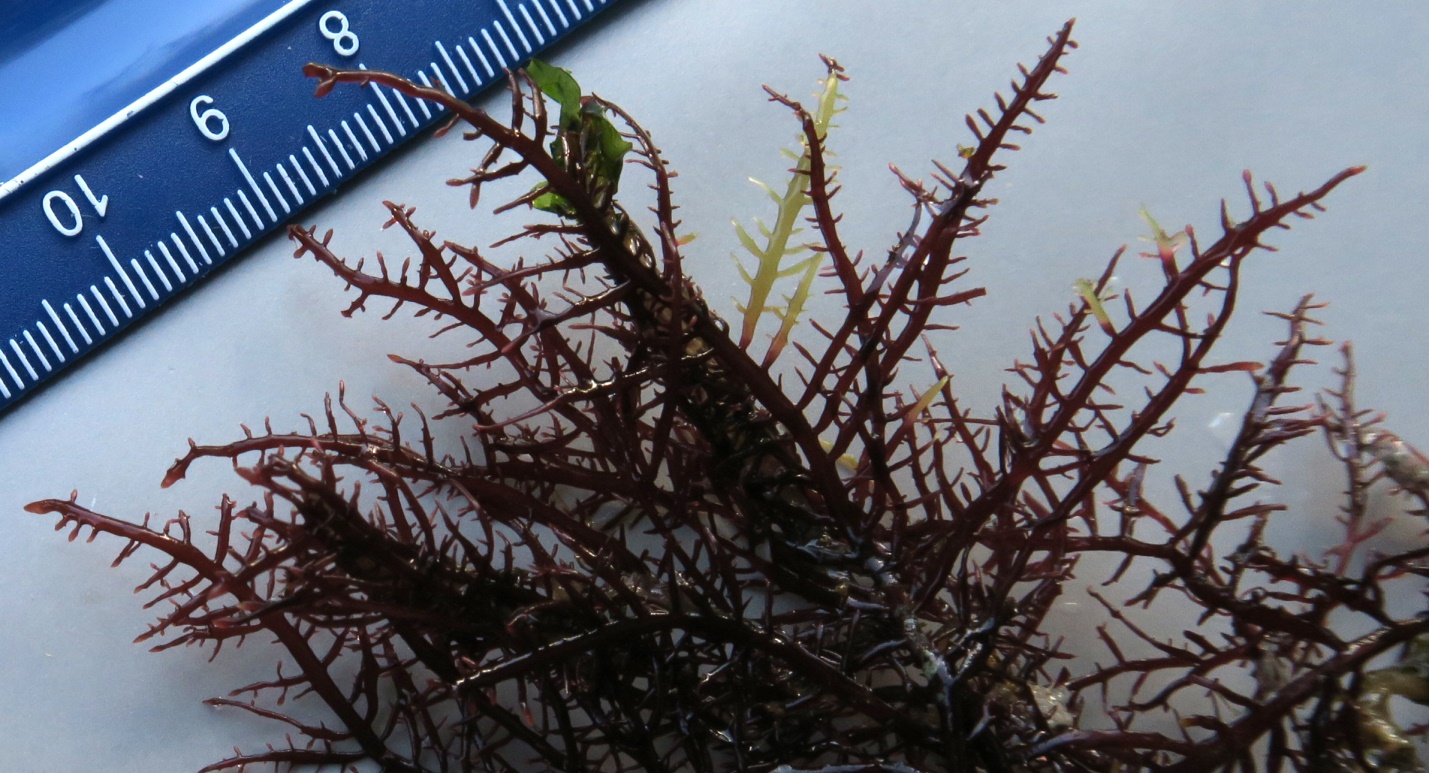
Figure 3: Viewed near a metric ruler (increments noted in mm & cm) and magnified greater than twice actual size, the dimensions and proportions of Gelidium purpurascens can be put to scale. Much more difficult to perceive from a photograph is the extreme flexibility of this seaweed. All parts, included the largest central axes can be bent back upon themselves tightly and they do not break. Terrace Beach, Ucluelet, B.C., Canada. October 27, 2025. Photo ID 27883 ©Seaweedwhisperings.com
Discussion:
There is a contradiction between the name of this seaweed, which evokes the concept gelatin or jelly, and the fact that it is actually quite stiff and cartilaginous. Even the tiniest tertiary branches are stiffly arrayed; they do not sway with ocean movements, they remain fixed in their positions. The main axes are the same, they are firm and certainly don’t wiggle like jelly. A little reading about the genus tells us that Gelidium seaweeds are a primary source of agar. Agar is substance used by humans in many kinds of foods as a gelatin substitute; it is a good stabilizing and thickening agent. So, yes, Gel Weed holds itself in a stable position.
The species we are interacting with, Gelidium purpurascens, is known to be the most cartilaginous of our region’s Gelidiums. The polysaccarides in its cell structure seem to be very skilled at “stabilizing”. What is it in this seaweed that wants to meet its watery realm in such a stiff or pre-set way? It’s almost like it feels the need to have and inner defence, or an invisible armor. This type of protection stands in contrast to the exterior protection strategies seen for example in the calcified coralline algae. So the armor for Gelidium is built inside the cell wall. We could say that Gelidium has an endoskeleton.
So, it has an interior armor, AND it is almost translucent. The interior armor therefore is invisible, and also highly flexible. And that flexibility is certainly one quality it shares with jelly. The external form suggests saw-tooth swords and or even a skeleton like structure – things that are quite rigid and structured. But the actual rigidity, comes from the inside, not from anything on the exterior.
We returned to the idea of the ‘look’ of a skeleton, particularly that of some fish. There is the central vertebral skeleton which we could liken to our central axis of Gelidium. Then there are rib bones coming off the vertebra in two opposing directions. Fish also have fin spines and some intramuscular bones, but what is interesting about the bones of fish is that they support the core muscles without inhibiting their mobility. This feels similar to Gelidium’s combined strength and flexibility.
This seaweed is confident but also it is not yet truly powerful. The confidence they have is still helping them develop. It certainly helps that they have an intrinsic inner armor. It gives protection as they explore the world. It supports their perky character and flexible strength. They can be bent, but most experiences won’t come anywhere near to breaking them. They have a stable sense of self. With that they can explore and keep investigating on all fronts, and that strong inner will center them. They’re too busy doing all of this to choose to exert their power over others. This is also expressed in the fact that they are not proactively aggressive but that they are definitely able and willing to defend themselves if the need should arise.
The same inner armor that protects them can been seen to limit their outward expression. Even though they are translucent, you can’t see what is going on inside for Gelidium. If they are frightened, if they are surprised, if they are grief stricken, if they are angry…, they look the same!! An outsider would have real difficulty observing any differences in their outer countenance. While it can be a positive to not be too emotional or dramatic, the fixed nature or ‘stability’ of expression that this seaweed has actually makes them a bit uninteresting. Perhaps one of their challenges is to learn ways to let down their guard and to share some of their interior experiences with others.
Gelidium purpurascens can have a way of operating that looks disorderly or inconsistent, but underneath that there is a strong determination. This seems to be another contradiction or juxtaposition of opposites. They have a willingness to try out a several options and then use whatever works best for them at the moment. In the next moment, well, it is entirely possible you will find them adopting the option they refused earlier. We see that in the morphology of this seaweed that can and does switch from opposite to alternate or from two-sided to many-sided branch orientations. So there is another kind of flexibility to them in that they hold their options open, and there is no loyalty to any one particular mode as always being best for what they’re up to.
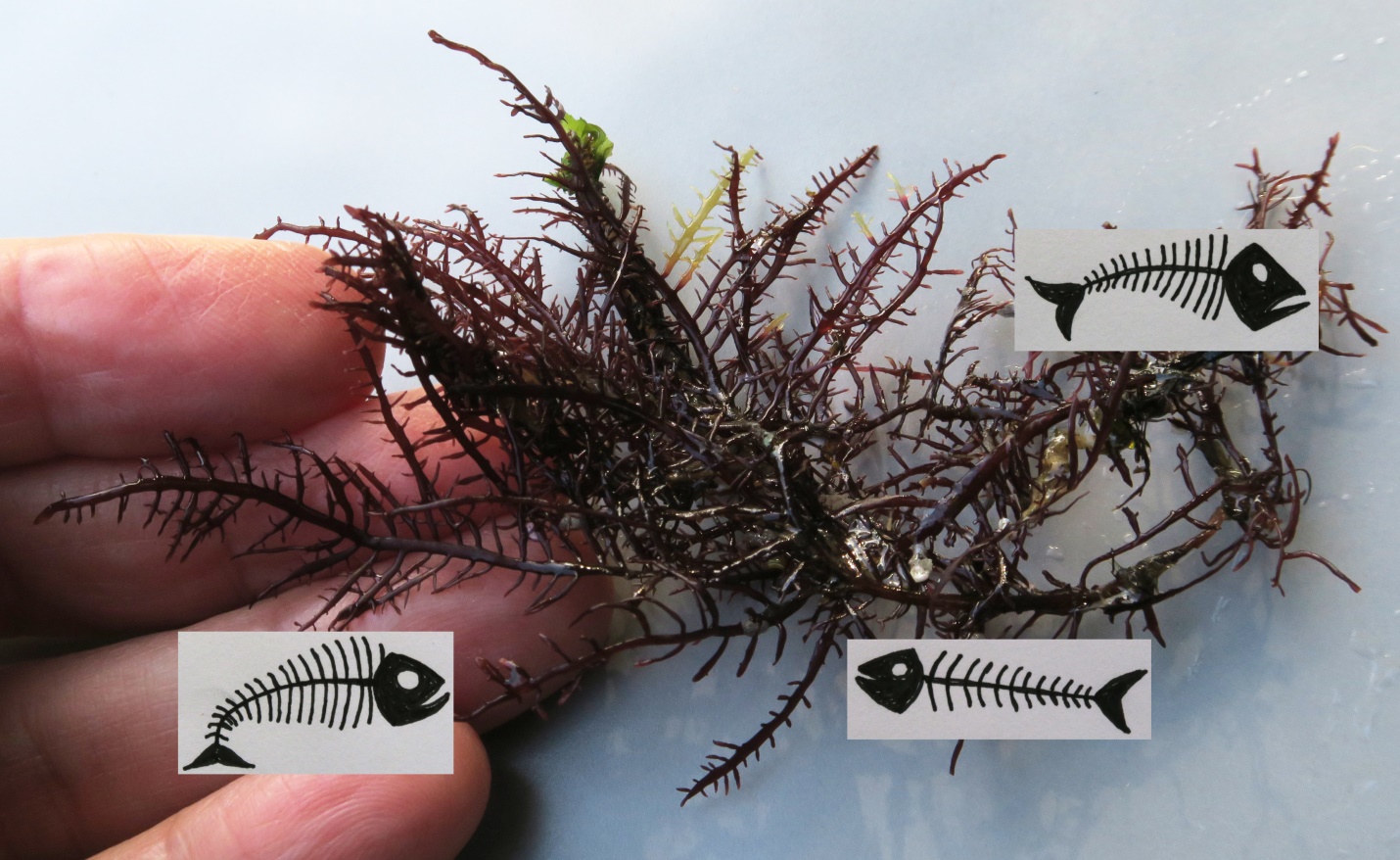
Figure 4: There is a resemblance between this seaweed’s form and the simplistic version of a fish skeleton. This visual link transfers over to themes we perceived in the energy of this seaweed such as flexible strength with an underlying internal stability. Terrace Beach, Ucluelet, B.C., Canada. October 27, 2025. Photo ID 27884 ©Seaweedwhisperings.com
Biology & Natural History Information:
Description:
A stiff red alga, growing 8 – 15 cm tall, mostly with rather regular distichous branching (two distinct rows of branches along a central stem lying flat on one plane), sometimes in part markedly polystichous (branches emerge in irregular rows all around the central stem), alternate or opposite, with branching at about 60˚ to the main axes. Branching can be from 2 to 4 orders and some individuals have a pyramidal outline. At their bases the main axes are nearly cylindrical or compressed, but typically axes are more compressed above. with coarse, regular branches coming off both sides of main axes. This species is larger, thicker, and more sparsely branched than its sister species Gelidium coulteri. Plants may be variously colored from yellowish to orange or brown, and maroon to deep purplish red.
Habitat:
Common on rock, (mid) low intertidal to upper subtidal (to depths of 8 meters).
North Pacific Distribution:
Alaska to Mexico; Japan.
Remarks:
Because of the quality of its plant gum agar, Gelidium is one of the world’s more economically important seaweed species. Agar is a jelly-like substance derived from various red algae and it replaces animal based gelatins for dishes requiring thickening and stabilizing such as in some ice creams, soups, sauces, puddings, gummy candies, etc. It is also used to create a stable, nutrient rich, gelatinous surface for growing microorganisms in microbiological research.
Classification:
Empire: Eukaryota
Kingdom: Plantae
Subkingdom: Biliphyta
Infrakingdom: Rhodaria
Phylum: Rhodophyta
Subphylum: Eurhodophytina
Class: Florideophyceae
Subclass: Rhodymeniophycidae
Order: Gelidiales
Family: Gelidiaceae
Genus: Gelidium
Species: Gelidium purpurascens N.L.Gardner 1927
Former name(s):
There are several heterotypic synonyms, studied mainly in California, that were determined to be morphological variants of G. purpurascens. The interested reader may find these listed on the AlgaeBase website.
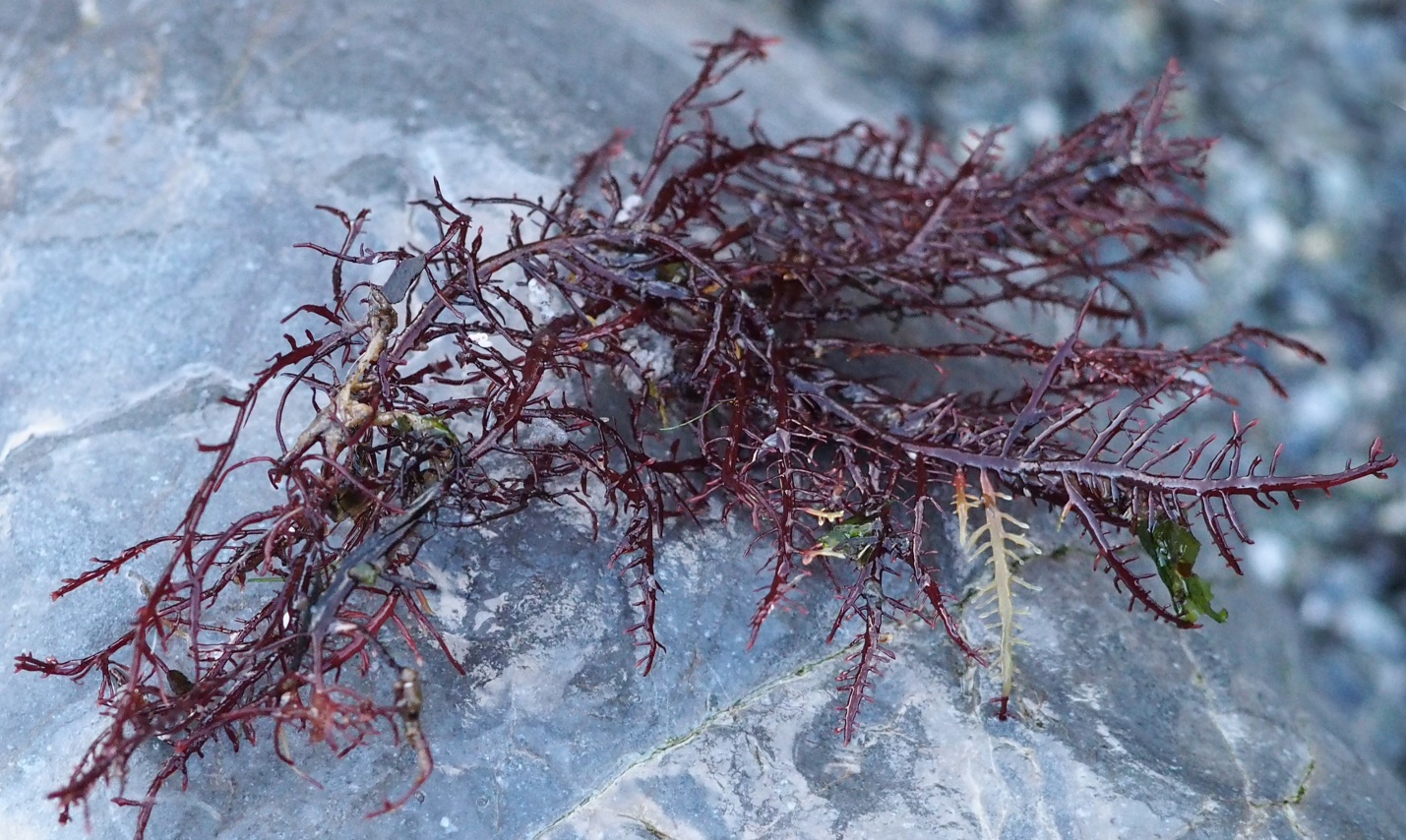
Figure 5: This cast ashore individual, set atop a rock for photography, displays the rich purplish red color that befits the species name, ‘purpurascens’. In situ, it is possible to find this seaweed in a range of colors including orange-brown, yellow, maroon and deep purplish red. Terrace Beach, Ucluelet, B.C., Canada. October 27, 2025. Photo ID 27885 ©Seaweedwhisperings.com
